

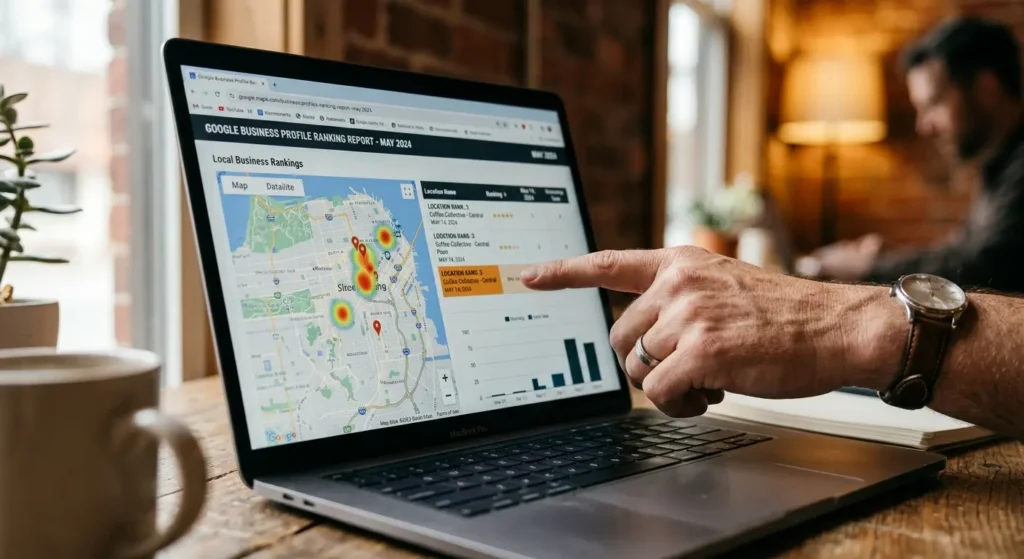
Real local SEO proof is specific: a dated screenshot showing an exact keyword and an exact map pack position, ideally checked from more than one point in the service area.
A vague claim like “we grew traffic 300%,” with no keyword, no location, and no baseline to compare against, isn’t proof. It’s marketing copy dressed up as a result.
What Real Local Ranking Proof Actually Looks Like
Legitimate local SEO results are checkable, not just impressive-sounding. Look for:
- A specific keyword paired with a specific position. “Ranked #2 for ‘plumber in Astoria'” tells you something. “Improved local visibility” does not.
- A date. Rankings shift constantly, so a screenshot with no timestamp could be from any point in the relationship, or before it even started.
- A baseline for comparison. Real proof shows where a business started and where it ended up, not just a single snapshot presented as the whole story.
- Geo-grid context where possible. A single ranking check from one location is a narrower picture than a spot-check across multiple points in the actual service area, closer to how customers in different neighborhoods actually experience the results. Tools like Local Falcon, BrightLocal, or Whitespark are built specifically for this kind of multi-point local rank tracking, so a provider citing one of them by name is a good sign they’re measuring it properly, not eyeballing a single search.
The Vague Claims Worth Questioning
Some numbers sound impressive precisely because they’re hard to verify. A few worth a direct follow-up question:
- “We grew traffic 300%.” Traffic to what, from where, over what time period? Without a keyword or a location tied to it, this could mean almost anything, including a small number growing to a slightly less small number.
- Domain authority as the headline metric. DA is a general website metric, not a local ranking signal. A provider leading with DA growth instead of map pack or Business Profile results is talking about the wrong scoreboard.
- Before-and-after screenshots with no dates or business names visible. Impossible to verify, and worth asking to see the real version of.
Case Studies vs Live, Checkable Examples
A polished case study in a slide deck is easy to make look good. A live example is harder to fake. Ask for a business, similar in size and category to yours if possible, that a provider currently manages, one you can search for yourself and actually find in today’s map pack results.
What to ask before hiring in the first place covers this same idea from the vetting side, verifying a track record is really just an extension of that same due diligence.
A Simple Way to Spot-Check a Claim Yourself
You don’t need to become a local SEO practitioner to sanity-check a result. If a provider cites a specific keyword and position, search that exact term yourself and see where the business shows up today.
It won’t tell you the whole history, rankings move, and a lot can change between when a claim was made and when you check it, but it’s a fast, free way to see whether a cited result holds up at all.
Frequently Asked Questions
What if a company won’t share real client results?
That’s worth taking seriously. Client confidentiality is a fair reason to withhold a full case study, but it’s not a reason to withhold every specific, verifiable detail. A provider unwilling to share a single checkable example, even anonymized where needed, is asking you to take their results entirely on faith.
Is it fair to ask for proof from a business exactly like mine?
It’s a reasonable ask, but not always realistic. A close match in category and size is ideal, but a provider with strong general local SEO results, shown specifically rather than vaguely, can still be a legitimate fit even without an identical case study.
What does a legitimate before-and-after local SEO screenshot actually show?
At minimum, a specific keyword, a specific position, and dates for both the starting point and the result. Bonus points for geo-grid context, ideally from a named tool like Local Falcon, BrightLocal, or Whitespark, showing how that ranking holds across more than one location in the service area.
Are stock or anonymized case studies still meaningful?
They can be, if the specifics are still intact, real keywords, real positions, real dates, just with the business name withheld for confidentiality. A case study stripped of every specific detail down to a percentage is a different thing entirely.
Should I be suspicious if a company only shows overall traffic growth, no rankings?
It’s worth a direct question, not an automatic red flag. Traffic can be a legitimate piece of the picture, but for a local SEO engagement specifically, map pack position and Google Business Profile activity are the more directly relevant proof points.
How many examples should a legitimate provider be able to show?
There’s no fixed number, but a provider with real, ongoing results should be able to produce more than one on request. A single, heavily polished case study and nothing else is worth asking about further.
Is it reasonable to ask to speak with a current client directly?
It’s a fair ask, though not every provider will be able to arrange it quickly, especially for a first conversation. A willingness to consider it, versus an immediate no, tells you something on its own.