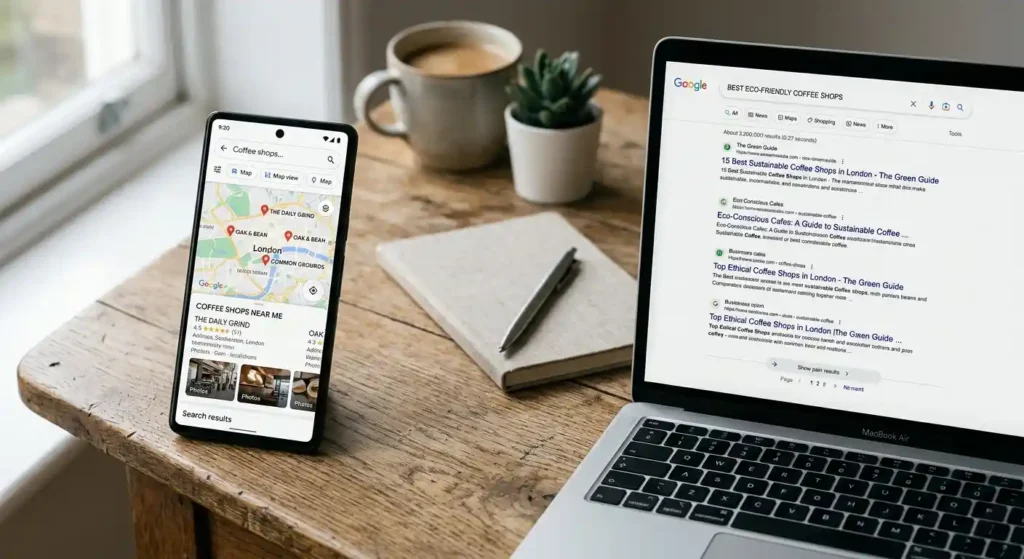

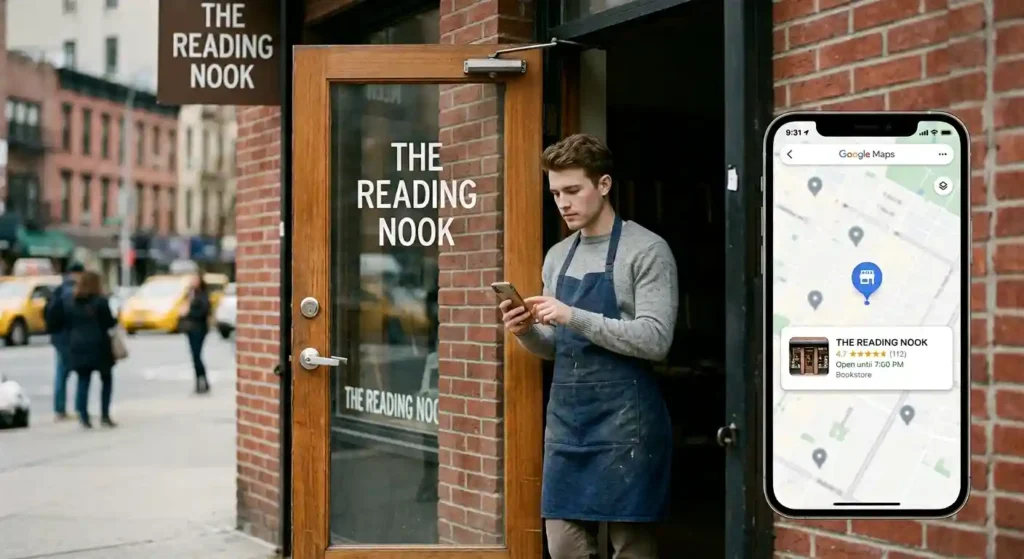
“Why isn’t my business showing up in local search” almost always comes down to one of five things: you’re not indexed, your business information is inconsistent somewhere across the web, your name is getting confused with a bigger brand, your content is too thin to compete, or you’re targeting terms too broad for a business your size to win.
None of these are permanent. All of them are diagnosable, and it’s the same diagnostic work behind our local SEO services.
If you manage a Google Business Profile, it’s tempting to assume the problem lives there. Sometimes it does, but “not showing up in local search” is a bigger question than “not showing up in the map pack.” Your website’s organic local rankings, your map pack position, and your visibility in Google’s AI-generated answers are three related but separate things, and a fix for one doesn’t automatically fix the others.
Google’s own Business Profile Help documentation is explicit that local results are based mainly on relevance, distance, and prominence, and every cause below ultimately traces back to one of those three.
This post covers the full range of causes across all three surfaces. If your specific issue turns out to be Google Business Profile-specific, we’ll point you to the right place.
It’s also worth knowing that “local search” isn’t only Google’s own results anymore. AI assistants increasingly pull local business data from Bing rather than crawling Google directly, which is part of why keeping your Bing Places listing accurate, not just Google Business Profile, has become a genuine visibility factor rather than a nice-to-have.
A business invisible on Bing can be invisible to an AI answer even while ranking fine in Google’s own map pack.
The Five Real Causes, at a Glance
| Cause | What It Actually Looks Like | Where to Go Next |
|---|---|---|
| Indexing issues | Your page or profile was never crawled, got deindexed, or has a stray noindex tag | Fix directly, see below |
| NAP inconsistency | Your name, address, or phone number differs across directories, not just on Google | Fix directly, see below |
| Name conflicts with a bigger brand | Google is showing a national or regional competitor with a similar name instead of you | Fix directly, see below |
| Content too thin | Your page doesn’t say enough, specifically enough, to earn the ranking | Local SEO Audit |
| Targeting too broad | You’re competing for “plumber” instead of “emergency plumber [neighborhood]” | Local SEO Audit |
| Your GBP itself is suspended, unverified, or mis-categorized | This is a Google Business Profile–specific problem, not a wider visibility one | (existing GBP suspension post: insert URL) |
| A manual action against your site | Google’s own human reviewers flagged a policy violation, not an algorithm | Check Search Console’s Manual Actions report directly |
You’re Not Indexed Yet, or You’ve Been Deindexed
A page Google hasn’t crawled, or has crawled and dropped, can’t rank for anything; it doesn’t matter how good the content is. This is the most binary cause on this list: either your page is in Google’s index or it isn’t, and there’s a direct way to check it.
Search site:yourdomain.com/the-exact-page in Google. If nothing comes back, the page isn’t indexed.
Common reasons: a noindex tag left on a page after launch (this happens constantly with staging sites pushed live without a final review), a canonical tag pointing to a different URL than the one you’re trying to rank, a robots.txt file blocking the folder, or simply a new page that hasn’t been crawled yet, which for a brand-new site can take anywhere from a few days to a few weeks.
It’s worth separating this from a manual action, which is a different and less common cause: Google Search Console has a dedicated Manual Actions report specifically because a manual action is a human reviewer’s decision, not an algorithm’s, typically triggered by spam-policy violations like unnatural links or manipulated content.
If your site has a manual action, some or all of it simply won’t show in search regardless of how well-indexed or well-optimized it otherwise is, and no amount of content or citation work fixes it until the underlying violation is corrected and a reconsideration request is filed. Checking this report directly takes thirty seconds and rules out an entire category of cause.
NAP Inconsistency Across the Wider Web, Not Just Google
Name, Address, Phone (NAP) consistency gets talked about as a Google Business Profile issue, but Google’s confidence in your business identity is built from everywhere your business is mentioned online: Yelp, Bing Places, industry-specific directories, your own old listings from a previous address, even a Facebook page you forgot existed.
If those sources disagree with each other, Google has to guess which one is authoritative, and “confused” is not a state that ranks well.
The usual culprits: a suite number present on some listings and missing from others, an abbreviated street name (“St” vs “Street”) that reads as a mismatch to an algorithm even though a human wouldn’t blink, a phone number that changed when you switched to VoIP and never got updated everywhere, or (the big one) an old address still live on directories from before you moved.
This isn’t a minor technicality: Whitespark’s 2026 Local Search Ranking Factors report, the industry’s longest-running annual survey of local SEO experts, continues to place citation signals, including consistency, among the top-five ranking factor groups for both the map pack and local organic results.
Your Business Name Conflicts With a Bigger Brand
If your business shares a name, or a close variation of one, with a larger regional or national company, Google’s local results can default to the more established entity, especially for shorter or more generic business names.
This isn’t usually a penalty against you specifically; it’s Google’s disambiguation logic favoring the account with more history, more reviews, and more citations behind it.
This is one of the harder problems on this list to fix quickly, because the solution isn’t a technical correction, it’s building enough distinct, locally-specific signal (a unique enough business description, consistent local citations, genuine local reviews) that Google stops treating your listing as the lesser match.
Your Content Is Too Thin to Compete
A page can be indexed, correctly labeled, and still lose because it simply doesn’t say enough. Thin local content usually means a service page that’s really just a national template with a city name swapped in: no real neighborhood references, no specific detail about how the service works locally, nothing a competitor’s page doesn’t already say better.
If you’re not sure which of these five is actually yours, guessing wastes time you don’t have. Here’s exactly what a real audit checks, and how long it actually takes.
You’re Targeting Terms Too Broad for Your Business’s Size
Competing for “plumber” with no geographic modifier puts a local business up against national directories, aggregators, and every plumber in every borough at once.
That’s a fight most local businesses can’t win, and losing it doesn’t mean your local SEO is broken; it means the target was never realistic. The fix isn’t more content, it’s more specific content, aimed at what a business your size can actually rank for.
FAQs
My business shows up for me but not for customers: is that even possible?
Yes, and it’s one of the most common false alarms in local SEO. Local results are personalized based on the searcher’s actual location and search history, and if you’re searching from your own business address, Google may be showing you results skewed by that proximity. Test from a different location (or ask someone in a different part of the city to check), or use an incognito window with location services set to a specific neighborhood, before assuming there’s a real problem.
How long does it take for a new business or new location to start showing up?
For Google Business Profile visibility specifically, verification alone can take anywhere from a few days to a couple of weeks. For genuine, competitive local rankings (not just “existing in search,” but actually ranking well), expect a longer runway, often a few months, as citations, reviews, and content have time to build real signal.
Does having zero or very few reviews keep me from showing up at all, or just push me lower?
Almost always the latter. Review count and quality are a prominence signal, one of three main local ranking factors, but they don’t gate visibility the way indexing does. A business with no reviews can still show up; it just tends to lose to a comparable business with a stronger review profile when the two are otherwise close.
I just moved locations. Why did my rankings disappear?
A location change resets a meaningful amount of local signal. Your old address’s citation history doesn’t automatically transfer, your Google Business Profile needs re-verification at the new address, and any directory listings still showing the old address are now actively working against you as NAP inconsistencies. This is usually recoverable, but it takes deliberate cleanup, not just an address update in one place.
Could a competitor have actually caused this, or is it always something on my end?
It’s worth ruling out, but it’s the less common explanation. A competitor ramping up their own local SEO can absolutely push you down in relative position without you having done anything wrong; see our competitor guide for how to check. But a sudden, sharp drop is more often self-inflicted or algorithm-related than competitor-driven.
How do I know if the cause is my website or my Google Business Profile?
A quick gut check: if you’re missing entirely from the map pack (the three-listing block with the map) but still show up in regular organic results, it’s very likely a GBP-specific issue: start with (existing GBP diagnostic post: insert URL). If you’re missing from both, or missing from organic results specifically while GBP looks fine, the cause is more likely on the website side: indexing, thin content, or targeting.
Should I try to fix this myself first, or go straight to an audit?
If you can confirm it’s a simple indexing problem (the site: search above), that’s worth checking yourself first; it’s a five-minute fix in many cases. Beyond that, the five causes above can look similar from the outside but require different fixes, and misdiagnosing which one you have is the single biggest reason DIY attempts stall out. A real audit removes the guessing.
Is it possible more than one of these is happening at once?
Yes, and it’s more common than a single, clean cause: a business that moved locations, for example, often has both a NAP inconsistency problem and a fresh-signal problem at the same time. This is part of why a structured audit tends to outperform chasing one symptom at a time.
I show up fine on Google but customers say an AI assistant can’t find me: what’s going on?
Check your Bing Places listing, not just Google Business Profile. Several AI assistants source local business data through Bing rather than Google, so a business that’s fully accurate on Google but stale or missing on Bing can be genuinely invisible to an AI-generated answer even while ranking normally in Google’s own results. This is a newer, separate cause from the five above and one that’s easy to miss because it doesn’t show up when you check Google directly.