

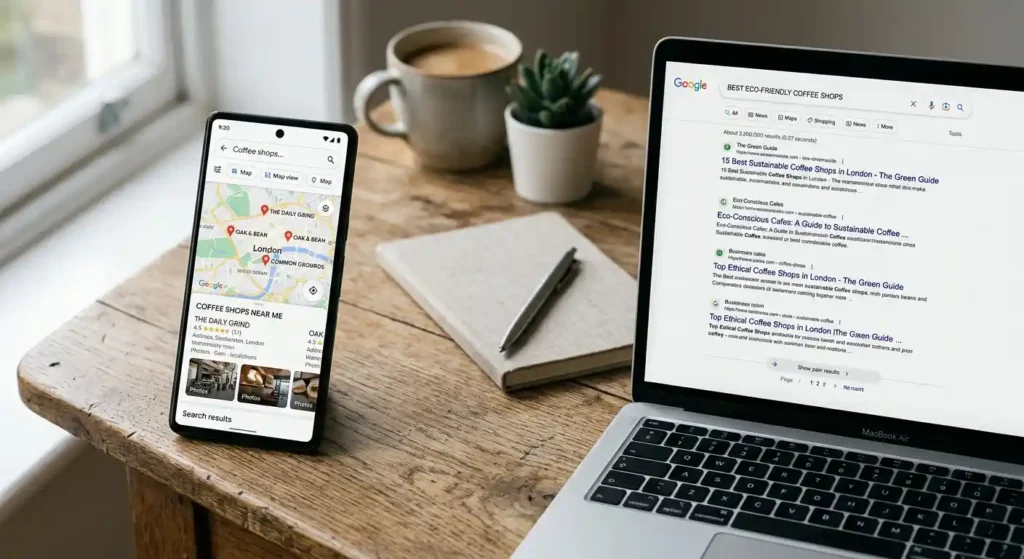
Local SEO and regular SEO are different disciplines chasing different search results, not two names for the same work. Local SEO targets the map pack and proximity-based visibility, governed by relevance, distance, and prominence.
Regular SEO targets organic website rankings broadly, governed by content, backlinks, and technical signals, with no geographic gate at all. Most physical or service-area businesses eventually need both, working differently, for different reasons.
The Core Difference at a Glance
| Local SEO | Regular SEO | |
|---|---|---|
| What it’s ranking | The map pack and location-based results | Standard organic website results |
| Governed by | Relevance, distance, and prominence (Google’s own stated local factors) | Content quality, backlinks, technical health, and overall site authority |
| Does distance matter? | Yes, directly. How close you are to the searcher is a core factor | No. A website can rank nationally with no connection to physical location |
| Typical trigger queries | “near me,” a neighborhood or borough name, implicit local intent | Broader informational, research, or national commercial searches |
| Typical conversion | Calls, direction requests, walk-ins, quote requests | Form fills, content downloads, online purchases, demo requests |
| Best fit for | Physical locations and service-area businesses (restaurants, clinics, contractors) | Businesses selling online, or building broad content and topical authority |
What Triggers the Map Pack
The map pack shows up for searches Google interprets as having local intent, and that’s a wider net than most people assume. It’s not just literal “near me” phrasing:
- Explicit local queries: “plumber near me,” “coffee shop in Astoria”
- Queries with an implied local intent Google detects automatically, even without a geo word, based on the type of business being searched for
- Category-plus-neighborhood or borough searches: “family dentist Park Slope,” “auto repair Bronx”
None of these queries care how good your website’s blog content is. They care whether your Google Business Profile matches the search, how close you are, and how well-established your business looks across the web.
What Drives Regular Organic Rankings
Regular organic rankings, the standard list of website results below or beside the map pack, run on an entirely different set of signals: content quality and relevance, backlink authority, technical site health, and overall domain trust. None of these have a distance component.
A well-built website with strong content and authority can rank for a broad, non-local search regardless of where the business is physically located. This is the discipline most people mean when they just say “SEO” without a qualifier.
Why the Same Business Can Rank Well in One, Poorly in the Other
Because the two systems weigh almost entirely different signals, a business can genuinely dominate one and be invisible in the other. A business with a fully optimized Google Business Profile and hundreds of reviews can own the map pack for its category while having a thin, rarely-updated website that never shows up in broader organic results below it.
The reverse happens just as often: a business with a strong, content-rich website and real backlink authority can rank well organically while having a neglected or incomplete Google Business Profile that keeps it out of the map pack entirely. Neither business is doing “SEO” wrong, exactly, each is just excelling at one discipline and neglecting the other.
When You Genuinely Need Both
Most businesses with any real-world footprint benefit from having both disciplines working, but the honest answer depends on your goals:
- You need local SEO, at minimum, if customers find you by searching a category plus a location, which covers nearly any business with a physical location or a defined service area.
- You need regular SEO layered on top if you also want to rank for broader informational or research-stage searches, serve a wider geography than your immediate neighborhood, or build content and authority that brings in traffic beyond “near me” intent.
- A single-location neighborhood business with no ambition beyond local customers can often get most of its value from local SEO alone.
- A business that sells online, serves multiple markets, or wants to be found for topic-level research, not just “who’s nearby”, needs regular SEO in the mix too.
Reading through this list and still not sure which side your business actually lands on? That’s a five-minute conversation, not a guessing game. Tell us how your customers actually search and we’ll tell you honestly which discipline should come first.
If you’re trying to figure out where your own business falls on that spectrum, local SEO is worth understanding on its own terms first, since it’s the piece most physical and service-area businesses need regardless of how far they take the rest.
Frequently Asked Questions
Do I need local SEO if I already have general SEO?
Usually yes, if you have a physical location or service area. Strong general SEO doesn’t put you in the map pack. That’s a separate ranking system driven by your Google Business Profile, proximity, and prominence signals, not by your website’s content or backlink profile.
Do I need regular SEO if I only care about local customers?
Not always, but it depends on how those local customers actually search. If most of your traffic comes from clear local-intent searches, local SEO alone can carry real weight. If you also want visibility for broader research-stage or informational searches within your market, regular SEO adds real value on top.
Can good general SEO accidentally hurt local pack rankings, or are they completely separate?
They’re separate systems, and one doesn’t directly hurt the other. A strong website generally supports the local organic results below the map pack, but the map pack itself runs almost entirely on Google Business Profile, distance, and prominence signals, independent of your broader site authority.
Does having a great website help my local pack ranking at all?
Indirectly, yes. Site content and technical health matter more for local organic results (the local blue links) than for the map pack itself. A stronger overall SEO foundation supports both, even though the map pack leans much more heavily on your Business Profile.
Is one discipline generally cheaper than the other?
Not reliably. Cost depends more on competitiveness and scope than which discipline you’re in. A highly competitive local category can cost as much as a moderate general SEO campaign, and vice versa.
Can a business skip regular SEO entirely and just focus on local?
Yes, plenty of single-location, neighborhood-focused businesses do exactly that, and it’s a legitimate strategy if your customer base genuinely doesn’t extend past local search behavior.
Does running Google Ads help either kind of organic ranking?
No. Paid search and organic rankings, local or regular, are entirely separate systems at Google. Ad spend doesn’t improve your map pack position or your organic website rankings.