

Every reputation management pitch sounds confident. The provider who’s actually right for your business is the one whose answers hold up when you ask specific questions, not the one with the smoothest deck.
Here’s exactly what to ask before you sign with a reputation management provider in New York City, what a strong answer sounds like, and what a weak one gives away.
What to Ask About Their Review-Response Process
Ask who writes the responses, how fast they turn around, and whether a person reviews every reply before it posts. A strong provider has a documented process for tone, escalation, and legal caution on sensitive complaints. A vague answer here usually means templated, generic responses that do more harm than good.
This question matters more than it sounds like it should, because response quality is the part of the service a customer actually sees.
A copy-paste “we’re sorry to hear that, please reach out” reply under a detailed, specific complaint reads as dismissive, and readers notice the pattern across multiple reviews faster than the business owner does.
- Who actually writes each response: someone familiar with your business, or a generic template?
- What’s the average turnaround time for a new review?
- Is there an escalation path for reviews mentioning legal or safety issues?
- Do responses get reviewed before they go live, or posted automatically?
- Have they handled your specific industry before, and can they describe a comparable situation?
A strong answer names a real turnaround window (usually under 48 hours), describes who signs off on sensitive replies, and can walk you through a real example without hedging. A weak answer talks in generalities about “prioritizing customer satisfaction” without describing an actual process.
How They Report Results
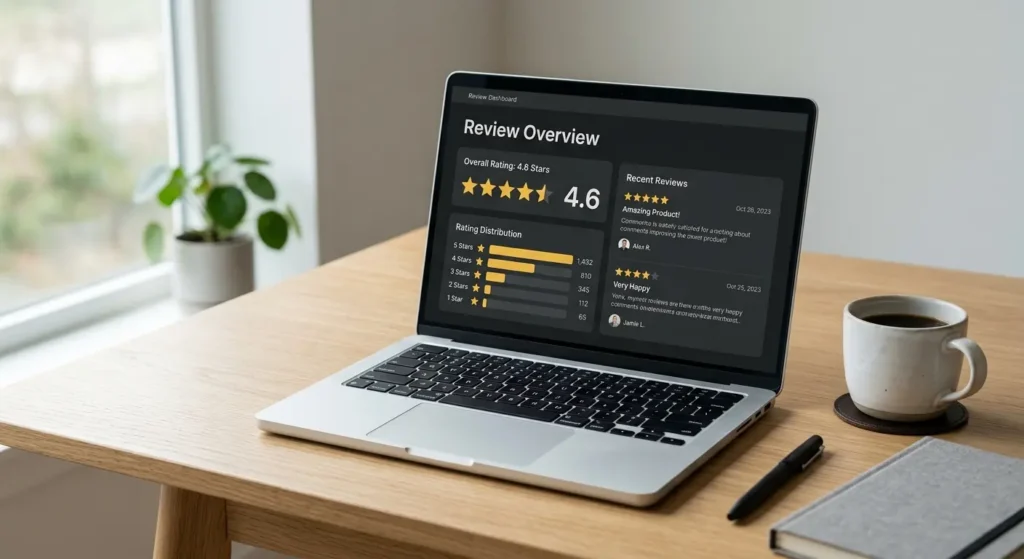
Ask what a monthly report actually includes: rating trend, review volume, response time, and sentiment by platform. A credible provider can describe this before you sign. If they can’t, you likely won’t get a report worth reading after.
The useful test isn’t whether they say “yes, we report monthly,” it’s whether they can show you a real number tied to a real date. Ask what your current rating and review count are right now, on the spot.
A provider actively monitoring your presence should know, or be able to look it up in seconds, not promise to “check and get back to you.”
- What metrics are tracked, and how often?
- Do you get a dashboard login, or is everything relayed secondhand?
- Can you see a sample report before signing?
- Does the report separate platforms, or blend everything into one number?
What Happens to the Reviews You Already Have
Ask directly how they’ll handle reviews posted before you signed, especially older negative ones. A capable provider audits your existing history first and builds it into the plan, rather than chasing new five-star reviews while ignoring what’s already dragging your rating down.
Watch for providers who only talk about the future. “We’ll get you more reviews” sounds good, but it sidesteps the harder, less flattering part of the job: your existing rating, your response rate on old reviews, and any negative pattern a competitor or customer would notice today.
A real audit covers your current rating, review count by platform, how many past reviews were ever responded to, and the status of any specific negative reviews still sitting unanswered. A provider that’s vague here is often vague about scope generally. See what’s included in reputation management for the baseline every contract should cover.
Do They Have Experience With Your Specific Situation?
Ask whether they’ve worked with businesses in your industry, and ask for a comparable example, not just a client logo.
Reputation work differs meaningfully by industry: a restaurant needs same-day response on a health-related complaint, a medical or legal practice needs extra care around what a response can and can’t say publicly, and a home services business often deals with disputes over completed work that a generic response template won’t handle well.
Ask for a specific example of a tough review they’ve responded to in a similar business, and how they handled it. A provider with real experience will have a story ready. One without it will pivot to talking about their process in the abstract.
Contract Length and What You’re Actually Committing To
Ask about contract length, cancellation terms, and what’s guaranteed versus best-effort. Reputation work compounds over months, so most legitimate contracts run three to six months minimum, and that’s not a red flag on its own, it reflects how long real review generation takes to show movement.
What matters is what’s in writing. Get the deliverables (response turnaround, reporting frequency, platforms covered) spelled out as actual terms, not described verbally and left out of the contract.
Ask specifically what happens if you want to leave early, and whether there’s a defined off-ramp if results genuinely aren’t showing after a few months.
The One Answer That Should End the Conversation
If a provider promises to remove or hide genuine negative reviews, that’s not a service question anymore, it’s a dealbreaker.
Reviews only come down if they violate a platform’s own policies, and the platform makes that call, not the agency managing your account. A provider claiming otherwise is either misrepresenting what’s possible or planning something that violates platform rules and puts your listing at risk.
Not sure what counts as a genuine red flag versus a normal sales pitch? Red flags to avoid →
Frequently Asked Questions
How long should a reputation management contract run?
Most legitimate contracts run three to six months at minimum, since review generation and rating recovery take time to show measurable movement. Be cautious of anything requiring a full year upfront with no review checkpoint built in.
What happens to bad reviews already posted before I sign?
A capable provider audits your existing reviews first, responds to what’s fixable, and factors your starting point into the plan, rather than only chasing new positive reviews while ignoring what’s already live.
How often should I get a report?
Monthly is standard for ongoing reputation work, covering rating trend, review volume by platform, and response times. Ask to see a sample report before signing so you know exactly what you’ll receive.
Should I ask how they generate new reviews?
Yes. Confirm the method stays within each platform’s rules. Incentivized requests or only asking known-happy customers (review-gating) can get your business account penalized on Google or Yelp.
What if a provider wants to handle everything without my input?
Be cautious. You should approve response tone and escalation triggers upfront, and be looped in immediately on anything involving a legal threat, safety complaint, or disputed reviewer identity.
Should I ask for case studies or references?
Yes, and a real provider will have them ready. Ask for an example from a business similar to yours, including what the starting rating was and what changed over a defined period.
Is an unusually low monthly price a red flag on its own?
Not automatically, but it’s worth asking exactly what’s included at that price. A rate well below the typical range often means monitoring only, with response writing or review generation priced as add-ons later.
Is it normal for pricing to vary a lot between providers?
Yes. Pricing depends heavily on how many platforms you’re on and how much active repair your existing reviews need. See reputation management pricing in NYC for a realistic range.
What should I ask if I’m switching providers, not hiring for the first time?
Ask specifically who owns your review platform logins and historical data once you leave. See switching providers for what to lock down before you go.